

This article first appeared over at This Week in Public Health
Artificial intelligence is rapidly changing journalism. Newsrooms are using AI to summarize information, generate drafts, analyze large datasets, translate stories, optimize content for search, and help distribute information to audiences.
Public health is beginning to use many of the same technologies.
But a new systematic review of artificial intelligence in journalism suggests that the most important lesson for public health may not be about AI at all. It may be about journalism as a method.
Journalists have spent generations developing practices for taking complicated information, determining what matters, placing it in context, verifying it, and communicating it quickly to people who are not experts. Public health has traditionally approached communication differently. Researchers generate evidence, practitioners translate it into guidance, communications teams package it, and eventually information reaches the public.
Generative AI potentially collapses much of that distance.
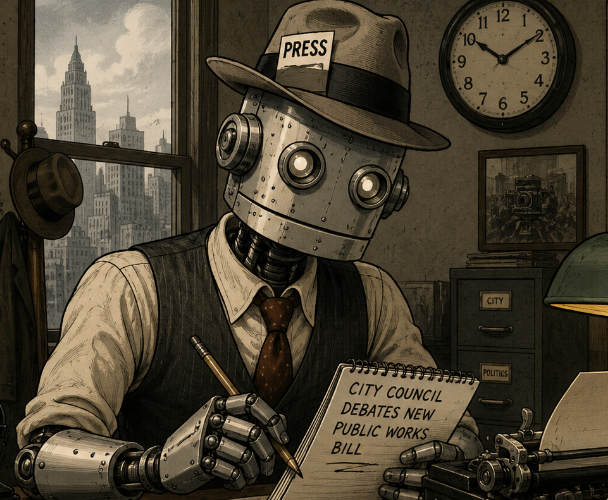
That creates an intriguing possibility: instead of simply using AI to automate traditional public health communication, public health organizations could combine AI with journalistic methods to create something closer to a continuously operating public health newsroom.
A systematic review published in Journalism and Media in August 2026 offers clues about what that might look like—and what could go wrong.
Journalism Has Already Become an AI Laboratory
Researchers reviewed 121 peer-reviewed studies published between 2020 and 2026 examining AI and machine learning in journalism and media. The researchers combined qualitative thematic analysis, structural topic modeling, and bibliometric network analysis to understand how AI is actually changing journalism.
Four major areas emerged from the literature. About 38% of studies examined news production and automation, roughly 25% focused on audience perceptions and content analysis, approximately 20% examined ethical and legal issues, and 17% studied implementation or the development of the field itself.
That distribution is interesting for public health because it shows that journalism has moved beyond asking whether AI can write.
The field is increasingly asking more difficult questions.
How should AI fit into professional workflows? How do people perceive AI-generated information? When should AI use be disclosed? Who remains accountable for errors? What happens to professional roles when machines perform tasks once reserved for trained professionals?
Public health will have to answer essentially the same questions.
The Biggest Lesson: AI Works Better as Part of a Workflow
One of the clearest findings from the review is that successful AI adoption does not appear to come from simply replacing journalists with machines.
Studies of organizations including the BBC, The Washington Post, and the Czech News Agency suggest that successful adoption depends on redesigning workflows around human-machine collaboration. Automation changes journalistic labor rather than eliminating it. Journalists increasingly edit, verify, contextualize, and improve AI-generated drafts.
Imagine a health department monitoring new research on overdose prevention. Hundreds of papers, reports, surveillance updates, policy announcements, and news stories might appear over several months.
AI could help identify new information, classify it, summarize it, compare findings, and produce preliminary drafts.
But the valuable product is not the automated summary. The valuable product is the editorial workflow surrounding it.
Someone still has to determine whether a finding is important. Someone needs to understand whether a study actually supports the headline being generated. Someone must recognize when a statistically significant result has little practical significance. Someone needs to identify conflicts with existing evidence. Someone has to determine what a finding means for a particular community.
Those are editorial decisions. And public health professionals already make them.
What journalism offers is a methodology for making those decisions quickly, repeatedly, and with an audience in mind.
Public Health Could Operate More Like a Newsroom
Traditional public health communication often begins with the institution.
A report is completed. A study is published. Surveillance data are updated. A guideline changes. Then someone asks how the information should be communicated.
Journalism begins somewhere else: What does the audience need to know right now?
That seemingly small change reorganizes the entire information-production process.
A journalism-inspired public health workflow could continuously monitor the scientific and policy environment, identify potentially important developments, evaluate the strength of the evidence, interview or consult subject-matter experts when necessary, contextualize findings against existing knowledge, and publish understandable explanations for different audiences.
AI could dramatically increase the scale at which such a system operates.
Natural language processing is already being used in journalism research for framing detection, sentiment analysis, topic categorization, summarization, classification, and cross-language content processing.
The same capabilities could support public health intelligence.
Instead of waiting for someone to notice an important study, systems could continuously scan the literature. Instead of manually reading hundreds of abstracts, AI could help identify emerging clusters of evidence. Instead of writing every communication product from scratch, communicators could begin with evidence-linked drafts that humans review and refine.
The result would not necessarily be automated public health. It could be augmented public health journalism.
Journalism Also Forces Public Health to Think About Newsworthiness
There is another methodological idea worth borrowing from journalism: not everything deserves equal attention. Scientific publishing does not necessarily distinguish between what is methodologically interesting and what matters to people’s lives.
Journalism must.
A journal may publish 150 new health studies in a week. Perhaps ten contain genuinely surprising findings. Five might contradict existing assumptions. Three could affect clinical or public health practice. One might reveal an emerging threat requiring immediate attention.
The journalistic question is therefore not simply: What was published?
It is: What happened that people need to understand?
That is a fundamentally different information-filtering problem.
AI makes this increasingly important because the constraint is no longer our ability to produce content. Generative systems can produce essentially unlimited amounts of it.
The scarce resource is attention.
Public health organizations adopting AI therefore need editorial judgment more than ever. Otherwise, automation simply accelerates the production of information into an environment already overwhelmed by information.
But Credibility Becomes Complicated
The journalism literature also contains a warning for public health. People do not necessarily respond to AI-generated information the way organizations expect.
Studies reviewed in the paper found that disclosing AI authorship can change perceptions of quality and credibility, but the effect varies considerably by context. Human-written articles tend to receive slightly higher quality ratings on average, although readers frequently cannot reliably distinguish human-generated from AI-generated journalism. Responses also vary with demographic characteristics, AI literacy, and cultural context.
That means simply adding a label saying “Generated with AI” may not solve the trust problem.
The authors argue that transparency strategies may need to be adapted to different audiences rather than implemented as universal disclosure policies.
Public health communication frequently deals with topics where institutional trust is already fragile: vaccines, infectious disease emergencies, reproductive health, environmental exposures, substance use, and health disparities.
Using AI to communicate faster may be technically impressive while simultaneously weakening credibility if audiences believe machines have replaced scientific or professional judgment.
The better model may therefore be to disclose the process, not merely the technology.
Instead of focusing exclusively on whether AI touched a piece of content, organizations could explain what AI did, what humans reviewed, what evidence was consulted, and who remains responsible for the final product.
The Editor May Become More Important Than the Writer
Perhaps the most interesting finding in the review is the emergence of post-editing as a professional activity.
When AI produces a first draft, human work moves downstream.
The journalist increasingly becomes someone who verifies claims, evaluates sources, corrects errors, adds context, recognizes missing perspectives, improves explanations, and ultimately decides whether something should be published. The review describes this as a transformation of journalistic labor rather than its disappearance.
Public health may experience exactly the same transition.
A communications specialist may spend less time staring at a blank document trying to write the first sentence of a fact sheet. Instead, they may spend more time interrogating a generated draft.
Does this accurately represent the evidence?
Did the system confuse association with causation?
Is an important limitation missing?
Does this recommendation apply to everyone?
Whose perspective is absent?
Is the headline stronger than the study warrants?
That requires expertise. Paradoxically, widespread AI adoption may make subject-matter expertise and editorial judgment more valuable, not less.
The Danger Is Scaling Errors Along With Information
AI creates another problem that journalism and public health share: automation can scale mistakes.
The review identifies misinformation, algorithmic bias, accountability, copyright, and transparency as major unresolved issues. Studies have documented stereotypes and representational inequalities in AI-generated text and imagery, while experimental work suggests AI-generated false information can sometimes achieve credibility comparable to authentic news.
An incorrect sentence written by one communicator might appear on one webpage. An incorrect claim embedded in an automated communication pipeline could appear in hundreds of newsletters, social posts, fact sheets, chatbot responses, or community reports before anyone notices.
Automation therefore changes the mathematics of quality control.
The faster information production becomes, the stronger verification systems must become.
Public Health Needs Editorial Infrastructure, Not Just AI Tools
This may ultimately be the most important implication of the journalism literature.
Organizations often think about AI adoption as purchasing technology.
The research suggests it is really an implementation problem.
The authors conclude that successful AI integration requires workflow redesign, incremental implementation, organizational learning, human-machine collaboration, professional training, and attention to transparency and ethical standards. They explicitly caution against treating automation primarily as a strategy for reducing costs.
That insight translates remarkably well to public health.
Giving every epidemiologist, researcher, health educator, and communications professional access to a large language model does not create an AI-enabled public health organization.
Organizations need rules governing sources. They need verification procedures. They need editorial standards. They need escalation pathways for uncertain or high-risk claims. They need clarity about which decisions require human judgment. They need mechanisms for correcting published information. And they need people accountable for the final product.
In other words, they need something resembling a newsroom.
A New Model for Public Health Communication
For decades, public health has largely treated journalism as an external institution. Researchers produce knowledge. Journalists report it.
AI creates an opportunity to reconsider that division.
Public health organizations can increasingly perform some functions traditionally associated with journalism themselves: continuously monitoring information, identifying important developments, synthesizing evidence, contextualizing findings, translating complexity, and rapidly communicating what matters.
But adopting the technology without adopting the methodology would miss much of the opportunity.
The journalism literature suggests that the future is unlikely to be an autonomous AI reporter quietly producing endless articles. Instead, it points toward hybrid systems in which machines handle portions of information processing and production while humans provide judgment, accountability, verification, and context.
The authors themselves emphasize that the field still needs stronger validation standards, longitudinal research, more evidence from the Global South, and research into accountability and changing professional roles.
Public health should pay attention to that experiment.
Because the question is quickly becoming larger than whether public health professionals should use ChatGPT or another AI tool.
The more consequential question is: What would public health look like if we combined the rigor of science, the speed and audience orientation of journalism, and the information-processing capacity of artificial intelligence?
That could represent a very different model of public health communication—one designed not simply to publish more information, but to help people understand what matters while it still matters.