
When I entered graduate school in 2009, I didn’t know what program evaluation was.
I didn’t really know what community psychology was, either.
I knew that I was interested in systems. I was interested in why some programs, organizations, and policies seemed to make a difference while others struggled. And I knew I wanted to work on problems that extended beyond what happened between two people in a clinical setting.
More than 15 years later, I still describe myself, first and foremost, as a community psychologist.
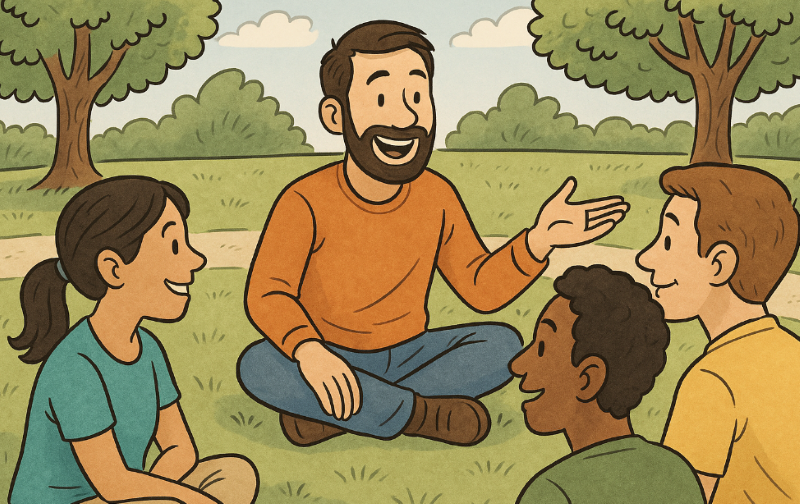
Recently, I had the opportunity to talk with a group of graduate students about the path from community psychology training to an applied career. Preparing for that conversation—and hearing the questions students asked—gave me an unexpected opportunity to reflect on what this career has actually taught me.
The biggest lesson may be this: Community psychology is less a job than a way of approaching problems.
And that way of thinking has taken me places I never could have anticipated when I started.
There Is No Typical Community Psychology Career
One of the first questions I was asked was simple: What do you actually do?
The answer is surprisingly difficult.
Over the years, my work has included program evaluation, implementation science, data analysis, measurement, public health, behavioral health, policy research, communication, technical assistance, and increasingly, the application of data science and artificial intelligence to social problems.
I’ve worked on projects involving suicide prevention, behavioral health systems, community health workers, research participation, medical debt, health equity, and implementation of evidence-based programs.
On any given day, I might be analyzing data, writing R code, reviewing research, designing an evaluation, talking with a project team, developing a new methodology, or trying to figure out how to communicate a complicated finding to someone who has absolutely no interest in hearing about the statistical model that produced it.
The topics change.
The underlying questions are remarkably consistent:
What is happening? Why is it happening? How do we know? And what can we do with that knowledge?
That is where community psychology has been extraordinarily useful.
Methods Are Portable. Learn Them Well.
If I were advising someone beginning a career in community psychology, evaluation, implementation science, or applied social research, I would tell them to become very good at something technical. For me, that became statistics, research methodology, data science, and eventually R. Technical skills create portability. Organizations may disagree about theories, funding priorities change, and entire areas of research can suddenly become more or less important. But organizations continually need people who can take messy information and turn it into something understandable and actionable.
The more important lesson, however, isn’t simply learning how to run an analysis. It is learning how to think methodologically: What do we know, and how do we know it? What assumptions are we making? What would convince us that we’re wrong? What does the evidence actually allow us to conclude? And, perhaps most importantly, what decision is this information supposed to help someone make? Those questions have followed me across virtually every project I’ve worked on.
The Goal Isn’t Research. It’s Useful Research.
One of the things I appreciate most about applied community psychology is its proximity to impact. Research can sometimes feel several steps removed from the problems it is studying, while applied evaluation gives us opportunities to shorten that distance. Several years ago, for example, I supported an evaluation of a national initiative that trained community health workers to address vaccine hesitancy. Our job wasn’t simply to determine whether activities happened; we wanted to understand what difference the work actually made. That meant thinking about counterfactuals: What might have happened if the intervention hadn’t existed? We ultimately estimated substantial effects on hospital costs and population health. I remember looking at those numbers and thinking, This work mattered. I wasn’t administering vaccines or working directly with community members, and I was several steps removed from the ultimate outcome. But the evaluation helped demonstrate whether an investment in communities had produced something valuable.
That is a lesson I have carried into much of our work at The Dawn Chorus Group: data become valuable when they help people make better decisions. An elegant analysis that nobody can use has limited value. A technically imperfect but appropriately designed analysis that helps an organization understand what to do next can be enormously consequential. Our job as evaluators isn’t merely to measure. It is to help people learn.
Good Community Work Requires Tolerance for Ambiguity
There is another part of this career that graduate training doesn’t always prepare us for: ambiguity. Much of community-based work happens in what I think of as the space of ideas. Sometimes I can sit down and write or analyze for hours; other times, I stare at a problem and get nowhere. Sometimes the most important insight in a project emerges from an analysis, while other times it comes from a conversation with someone who sees the problem completely differently. I’ve learned to appreciate that uncertainty rather than immediately trying to eliminate it.
Community problems are complicated because communities are complicated. There are competing priorities, different kinds of expertise, political constraints, historical relationships, funding limitations, organizational cultures, and personal experiences. You cannot simply engineer those things away. Sometimes you need enough space for people to think together. That requires a tolerance for uncertainty, but it also creates the possibility of producing something with people rather than for them. To me, that remains one of the central values of community psychology.
Relationships May Be the Most Underrated Research Method
Graduate programs spend enormous amounts of time teaching research methods. We spend considerably less time teaching people how to email someone they don’t know, and that might be a mistake. One of the most important lessons I learned from my graduate mentor, Dr. Abe Wandersman, was remarkably simple: talk to people. Ask questions, send the email, introduce yourself, tell someone when their work interests you, ask how they approached a problem, and offer to help when you can. People who seem impossibly accomplished are still people. Most became experts because they were fascinated by something and spent a long time thinking about it, and many are perfectly happy to talk with someone who shares that fascination.
Some of the most interesting opportunities of my career have emerged from conversations that had no obvious purpose when they began. A conversation about a research question becomes a collaboration. A colleague moves to another organization and calls three years later. Someone remembers an analysis you did. A former student sends an opportunity. A person you helped introduces you to someone confronting exactly the problem you’ve been thinking about. You cannot plan those chains of events, but you can create the conditions in which they are more likely to happen.
Make Your Work Count More Than Once
Another principle I’ve gradually adopted is to try to make everything I do count more than once. Every project teaches you something beyond its immediate subject matter. You might learn a new statistical method, develop a better way to visualize results, discover a broader theoretical question hiding inside an implementation problem, learn a new programming technique because a dataset demands it, or find a better way to communicate complicated research while explaining a project to a stakeholder. The important thing is to capture those lessons and carry them into the next problem.
Careers in applied research are rarely linear. Funding changes, technologies change, organizations change, and public priorities change. The ability to learn, transfer, and recombine skills may therefore be more valuable than expertise in any single topic. The uncomfortable reality of an academic-ish career is that learning never really stops. You finish the dissertation. Congratulations. Now comes the next dissertation.
Community Psychology Exists Far Beyond Universities
One reason I wanted to share this reflection is that students sometimes have a narrow picture of what a career in psychology can look like. Clinical training does not necessarily mean clinical practice, and research training does not necessarily mean becoming a professor. Community psychologists and other applied social scientists can work in research institutes, consulting firms, nonprofits, government contractors, foundations, health systems, technology companies, pharmaceutical companies, public agencies, and countless other settings.
These organizations need people who understand both human behavior and systems. They need people who can work with data without losing sight of the people represented by those data, move between scientific evidence and practical decisions, and enter an unfamiliar problem, learn quickly, ask useful questions, and help a group figure out what comes next. Those are community psychology skills—even when the job title never uses the words community psychologist.
A Career Built Around Questions
Looking back, my career makes considerably more sense in retrospect than it did while I was living it.There was no master plan. There were mentors, projects, skills I deliberately developed, and others I learned because a project suddenly required them. There were emails I decided to send and conversations that unexpectedly turned into collaborations. Some projects disappeared when funding did, while others opened entirely new areas of work. Through all of it, community psychology provided something more useful than a predefined career path: it provided a way of approaching problems.
For me, that means looking at systems, not just individuals; asking who is affected and who is missing from the conversation; using evidence while connecting that evidence to decisions; taking methods seriously without confusing methodological sophistication with usefulness; building with people rather than for them; and staying curious enough to keep learning. Perhaps most importantly, it means remembering that the ultimate purpose of all this research, evaluation, analysis, and implementation work is not simply to generate more knowledge. It is to use what we learn to add some good to the world. After 15-plus years, that’s still a pretty compelling reason to be a community psychologist.